
Coffee Description
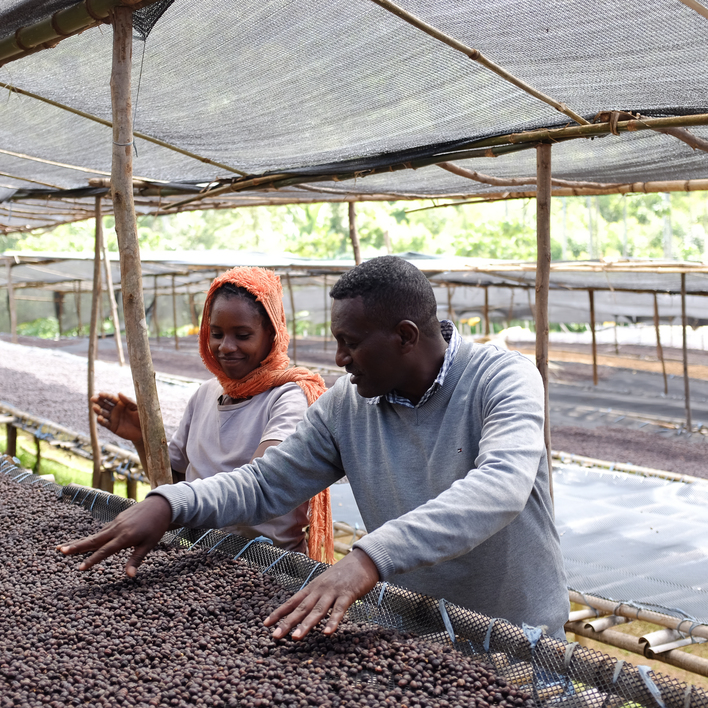
Typical processing for sun-dried natural Ethiopian coffee sees cherries entering
the washing station atop donkeys or carried by hand. Usually contained in a plastic bag at this stage, the cherries are weighed with a traditional scale (often painted a rich shade of
sea green) and the volume entered against the producer’s name in the washing station’s logbook. The smallholder receives their money, which is often used to purchase essentials such as food and school supplies, or to pay for rent on their huts and small sections of land.
Once the cherries are logged, they are usually carried straight to the drying table. But as we at Catalyst Trade prefer and pay premiums for—the first step post- harvesting for our Black Honey coffee is a quick hand sorting for consistency in coloration before being dumped into float tanks so that lower-density cherries can surface and be skimmed off for lower grade coffees or local consumption. The higher- density cherries sink to the bottom, displaying their quality by their weight. Lower density cherries are sent to the drying beds to be processed for lower grade coffees and local consumption.
For the higher density cherries, another hand sorting follows the floating process to give good uniformity for pulping. For our Black, Red and White honey processed coffees, we calibrate the disc pulper to allow for greater control and speed of pulping, which we take very slowly. The primary goal here is to minimize parchment and seed damage while really maximizing the mucilage content.
RED HONEY
Following pulping, we ferment the parchment slated for our Red Honey coffees
for a very controlled fermentation cycle. Then the mucilage-laden parchment is moved
to shaded drying beds, where we keep it slowly drying entirely under a shade canopy
with excellent airflow. The drying with shade adds 4 to 5 days overall drying time with
this Red Honey, and affords us a stable distribution of moisture content throughout the
cellular structure, along with a dialed in water activity. While shade drying gives just a
little more control than full sun-drying, it can be a little tricky to cover the parchment at
the right times. We find this strong uniformity in the drying of all the coffees is critical in
a good honey process.
WHAT IS BEHIND THE COLOR NAMES?
Black, Red, and White Honey are so called due to the color of the parchment.
Black Honey coffees carry characteristic black splotches from the heavy mucilage load.
Red Honey coffees are also splotched, but less so than black and the splotches are
more red than black. White Honey carries the least mucilage and is more yellow/white in
hue over all.

Roast Level from the Roaster
Refers to the roast level in comparison with other coffees from the roaster
Light




Variety
Wush Wush

Process
Honey
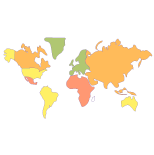
Region
Kaffa
About Dinkalem Ademe of Ethiopia
Owner: Dinkalem Ademe
General Manager: Dinkalem Ademe
Assistant Manager: Shimelis Ademe
Mechanic: Endalem Wedajo (4+ experience)
Coffee Varieties: 75/210 and 74/212, smaller quantities of 74/110 and 74/165 and local
Landrace varieties, naturally adapted from the Wush Wush variety
Name of Site/Village: Wush Wush
Name of District: Ginbo
Name of Zone: Keffa
Name of Region: SNNPR Region
Washing Station/Farm size: 2 ha
GPS Coordinates: N 07 17.627 E 036 09.106
Smallholder Farm Elevations: 1850 up to 1950 MASL
Soil Type:
Climate: Rainy Season: May through October, though it usually still rains at least 3 hours a day in the dry season
Kaffa, Ethiopia

Tilly's Coffee
Tilly's Coffee, formerly known as Theodore's Coffee, is a small-batch roasting company led by Darwin Pavon, a Honduran coffee grower. Our journey began more than two decades ago when we discovered the world of premium coffee and the diverse range of varieties available in the market. Theodore's Coffee was established to bridge the gap between growers and discerning consumers, aiming to address the inequalities prevalent in the coffee industry and secure better returns for growers.
Over the years, we have experienced remarkable growth and recently celebrated five years of roasting excellence in the United States. Our roastery is located in Owosso, Michigan, a charming community adorned with captivating historic landmarks. As a company, we take pride in directly importing 90% of our coffees from dedicated growers in Central America, while the remaining 10% is sourced through our valued partner, CATALYST CONSULTING, who provides us with exceptional Ethiopian coffees.
Our unwavering commitment lies in meticulously roasting each small batch with an unwavering passion, fueled by our curiosity to understand how every customer savors their cup of coffee. Our core values serve as the guiding principles that shape our business:
QUALITY: We meticulously source, roast, and deliver the finest coffees from exceptional farms across the globe.
PEOPLE: We deeply value the hands that contribute to our business, from the growers to our cherished customers, as well as our friends and family.
INTEGRITY: Upholding the highest standards of integrity is paramount to us. We engage exclusively with like-minded companies and individuals who share our commitment to ethical business practices.
For further information or any inquiries, we encourage you to reach out to us at info@theodorescoffee.com. We are delighted to provide you with more insights and answer any questions you may have.
